
Search Result
Found "247" results return by the query.
Manufacturer: Elabscience
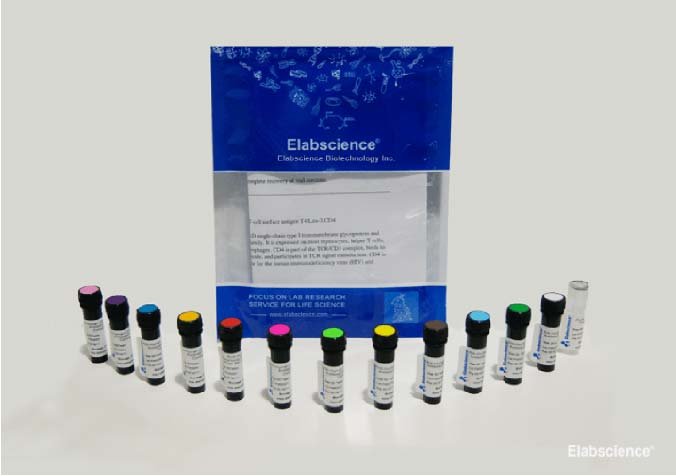
CD8a is a 32-34 kD type I glycoprotein. It forms a homodimer (CD8a/a) or heterodimer (CD8a/b) with CD8b. CD8, also known as T8 and Leu2, is a member of the immunoglobulin superfamily found on the majority of thymocytes, a subset of peripheral blood T cells, and NK cells (which express almost exclusively CD8a homodimers). CD8 acts as a co-receptor with MHC class I-restricted T cell receptors in antigen recognition and T cell activation and has been shown to play a role in thymic differentiation. Two domains in CD8a are important for function: the extracellular IgSF domain binds the α3 domain of MHC class I and the cytoplasmic CXCP motif binds the tyrosine kinase p56 Lck.

Manufacturer: Elabscience
CD19 is a 95 kD glycoprotein also known as B4. It is a member of the Ig superfamily, expressed on all pro-B to mature B cells (during development) and follicular dendritic cells. Plasma cells do not express CD19. CD19, in association with CD21 and CD81, forms a molecular complex integral to B cell activation.
Manufacturer: Elabscience
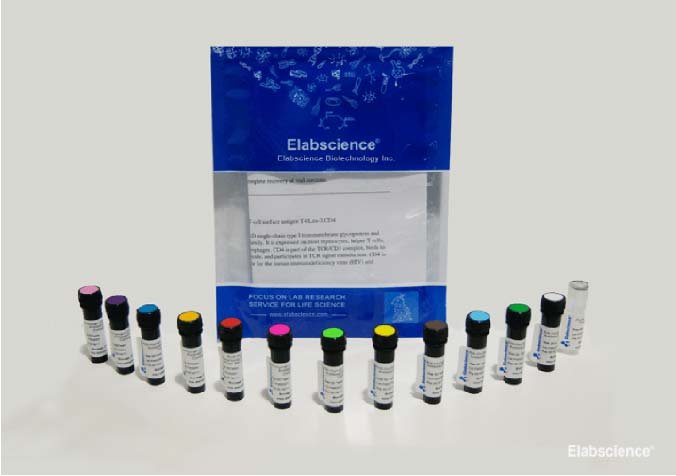
CD3, also known as T3, is a member of the Ig superfamily and primarily expressed on T cells, NK-T cells, and at different levels on thymocytes during T cell differentiation. CD3 is composed of CD3ε, δ, γ and ζ chains. It forms a TCR complex by associating with TCR α/β or γ/δ chains. CD3 plays a critical role in TCR signal transduction, T cell activation, and antigen recognition by binding the peptide/MHC antigen complex.

Manufacturer: Elabscience
CD25 is a 55 kD glycoprotein, also known as the low affinity IL-2Rα, Ly-43, p55, or Tac. It is expressed on activated T and B cells, thymocyte subset, pre-B cells, and T regulatory cells. In association with CD122 (IL-2Rβ) and CD132(common γ chain), CD25 forms the high affinity signaling IL-2 receptor.
Manufacturer: Elabscience
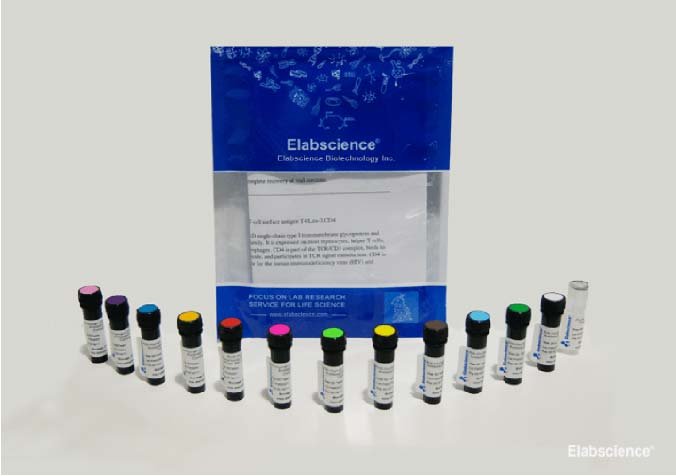
CD4, also known as T4/Leu-3, is a 55 kD single-chain type I transmembrane glycoprotein and member of the immunoglobulin superfamily. It is expressed on most thymocytes, helper T cells, type II NKT cells, and monocytes/macrophages. CD4 is part of the TCR/CD3 complex, binds to β2 domain from the MHC class II molecule, and participates in TCR signal transduction. CD4 is the receptor of IL-16 and is a coreceptor for the human immunodeficiency virus (HIV) and human herpes virus 7 (HHV-7).
Manufacturer: Elabscience
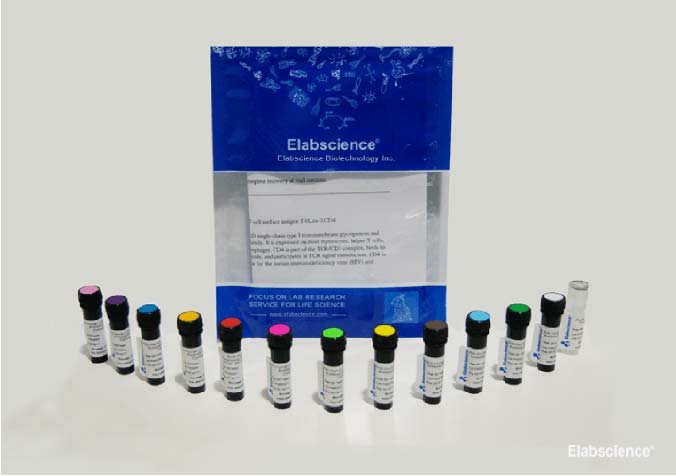
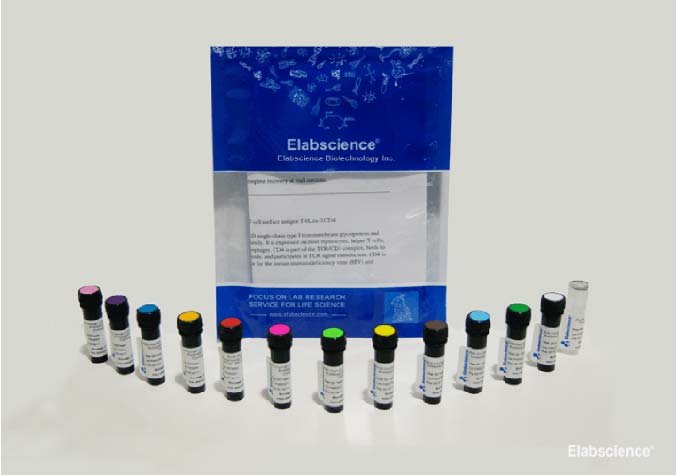
CD4, also known as T4/Leu-3, is a 55 kD single-chain type I transmembrane glycoprotein and member of the immunoglobulin superfamily. It is expressed on most thymocytes, helper T cells, type II NKT cells, and monocytes/macrophages. CD4 is part of the TCR/CD3 complex, binds to β2 domain from the MHC class II molecule, and participates in TCR signal transduction. CD4 is the receptor of IL-16 and is a coreceptor for the human immunodeficiency virus (HIV) and human herpes virus 7 (HHV-7).
Manufacturer: Elabscience
CD45 is a 180 - 240 kD single chain type I membrane glycoprotein also known as leukocyte common antigen (LCA) and T200. It is a tyrosine phosphatase expressed on the plasma membrane of all hematopoietic cells, except erythrocytes or platelets. CD45 is a signaling molecule that regulates a variety of cellular processes including cell growth, differentiation, cell cycle, and oncogenic transformation. CD45 plays a critical role in T and B cell antigen receptor-mediated activation by dephosphorylating substrates including p56Lck, p59Fyn, and other Src family kinases. CD45 non-covalently associates with lymphocyte phosphatase-associated phosphoprotein (LPAP) on T and B lymphocytes. CD45 has been reported to bind galectin-1 and to be associated with several other cell surface antigens including CD1, CD2, CD3, and CD4.

Manufacturer: Elabscience
CD14 is a 53-55 kD glycosylphosphatidylinositol (GPI)-linked membrane glycoprotein also known as LPS receptor. CD14 is expressed at high levels on monocytes and macrophages, and at lower levels on granulocytes. Some dendritic cell populations such as interfollicular dendritic cells, reticular dendritic cells, and Langerhans cells have also been reported to express CD14. As a high-affinity receptor for LPS, CD14 is involved in the clearance of gram-negative pathogens, and in the upregulation of adhesion molecules and expression of cytokines in monocytes and neutrophils.