
Search Result
Found "341" results return by the query.

Manufacturer: Elabscience
CD64 is a 72 kD single chain type I glycoprotein also known as FcγRI and FcR I. CD64 is a member of the immunoglobulin superfamily and is expressed on monocytes/macrophages, dendritic cells, and activated granulocytes. The expression can be upregulated by IFN-γ stimulation. CD64 binds IgG immune complex. It plays a role in antigen capture, phagocytosis of IgG/antigen complexes, and antibody-dependent cellular cytotoxicity (ADCC).

Manufacturer: Elabscience
CD9 is a 24 kD type III transmembrane protein also known as tetraspanin, MRP-1 and DRAP-24. It is a member of the tetraspan family (spanning the membrane four times) found on platelets, B cell progenitors, activated lymphocytes, granulocytes, endothelial cells and epithelial cells. CD9 induces adhesion, platelet aggregation, and B cell development. CD9 has been shown to associate with CD63, CD81, CD82, and CD36 and to bind to β1 integrins.

Manufacturer: Elabscience
CD41 is a 125/25 kD α subunit of the gpIIb/IIIa (CD41/CD61) complex. CD41 is a heterodimer composed of a heavy chain (gpIIbα) and light chain (gpIIbβ) linked by a single disulfide bond. It is a member of the integrin family primarily expressed on platelets and megakaryocytes. CD41 has been reported to be involved with platelet aggregation and platelet attachment to the ECM. CD41/CD61 complex acts as the receptor for fibrinogen, fibronectin, Von Willebrand factor and thrombin.
Manufacturer: Elabscience
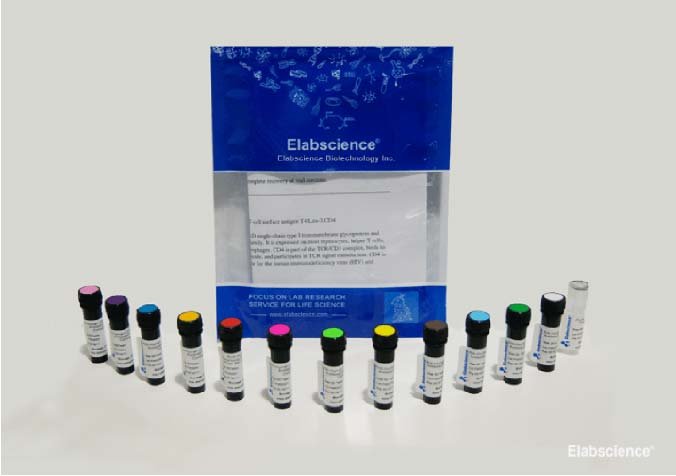
CD4 is a 55 kD protein also known as L3T4 or T4. It is a member of the Ig superfamily, primarily expressed on most thymocytes, a subset of T cells, and weakly on macrophages and dendritic cells. It acts as a coreceptor with the TCR during T cell activation and thymic differentiation by binding MHC class II and associating with the protein tyrosin kinase, lck.
Manufacturer: Elabscience
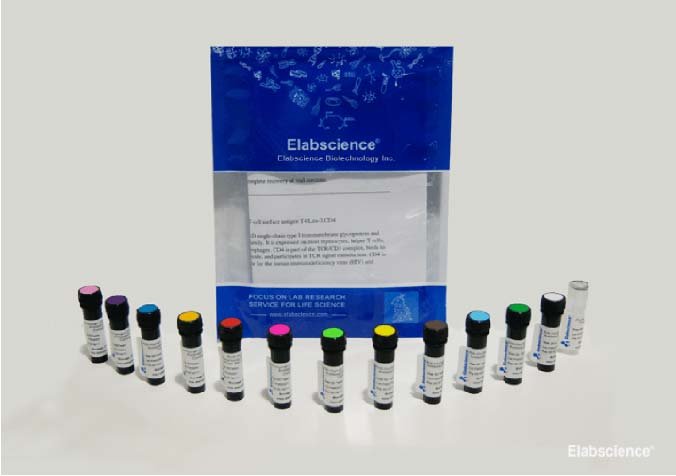
CD44 is a 80-95 kD glycoprotein also known as Hermes, Pgp1, H-CAM, or HUTCH. It is expressed on all leukocytes, endothelial cells, hepatocytes, and mesenchymal cells. As B and T cells become activated or progress to the memory stage, CD44 expression increases from low or mid levels to high levels. Thus, CD44 has been reported to be a valuable marker for memory cell subsets. High CD44 expression on Treg cells has been associated with potent suppressive function via high production of IL-10. CD44 is an adhesion molecule involved in leukocyte attachment to and rolling on endothelial cells, homing to peripheral lymphoid organs and to the sites of inflammation, and leukocyte aggregation.

Manufacturer: Elabscience
CD4, also known as T4/Leu-3, is a 55 kD single-chain type I transmembrane glycoprotein and member of the immunoglobulin superfamily. It is expressed on most thymocytes, helper T cells, type II NKT cells, and monocytes/macrophages. CD4 is part of the TCR/CD3 complex, binds to β2 domain from the MHC class II molecule, and participates in TCR signal transduction. CD4 is the receptor of IL-16 and is a coreceptor for the human immunodeficiency virus (HIV) and human herpes virus 7 (HHV-7).

Manufacturer: Elabscience
CD8a is a 32-34 kD type I glycoprotein. It forms a homodimer (CD8a/a) or heterodimer (CD8a/b) with CD8b. CD8, also known as T8 and Leu2, is a member of the immunoglobulin superfamily found on the majority of thymocytes, a subset of peripheral blood T cells, and NK cells (which express almost exclusively CD8a homodimers). CD8 acts as a co-receptor with MHC class I-restricted T cell receptors in antigen recognition and T cell activation and has been shown to play a role in thymic differentiation. Two domains in CD8a are important for function: the extracellular IgSF domain binds the α3 domain of MHC class I and the cytoplasmic CXCP motif binds the tyrosine kinase p56 Lck.

Manufacturer: Elabscience
Biotinidase, also known as biotinase and BTD, is a ubiquitous mammalian cell enzyme which expressed at high levels in the liver, serum, and kidney. Its primary function is to cleave biotin from biocytin, preserving the pool of biotin for use as a cofactor for biotin dependent enzymes, namely the 4 human carboxylases. Biotinidase also recycles biotin from enzymes in the body that use it as a helper component in order to function. These enzymes, known ascarboxylases, are important in the processing offats,carbohydrates, andproteins. Biotin is attached to these carboxylase enzymes through anamino acid(the building material of proteins) calledlysine, forming a complex calledbiocytin.