
Search Result
Found "3416" results return by the query.
![Elab Fluor® Violet 450 Anti-Human CD20 Antibody[2H7] (E-AB-F1212Q)](https://www.unibiotech.in/upload/product/hw50ks.vLkHpb.jpg)
Manufacturer: Elabscience
CD20 is a 33-37 kD, four transmembrane spanning protein, also known as B1 and Bp35. CD20 is expressed on pre-B-cells, resting and activated B cells (not plasma cells), some follicular dendritic cells, and at low levels on a T cell subset. CD20 is heavily phosphorylated on activated B cells and malignant B cells. Homo-oligomeric complexes of CD20 are thought to form Ca2+ conductive ion channels in the plasma membrane of B cells. The CD20 molecule is involved in B-cell activation and is associated with various Src family kinases (Lyn, Lck, Fyn). It exists in a complex with MHC class I and II, CD53, CD81, and CD82.
![PE/Elab Fluor® 594 Anti-Rat CD3 Antibody[G4.18] (E-AB-F1228P)](https://www.unibiotech.in/upload/product/xbjlkc.kgDjEI.jpg)
Manufacturer: Elabscience
CD3 is a complex composed of δ, γ, ε, and ζ chains. They are 20-25 kD members of the immunoglobulin superfamily and associated with the T cell receptor (TCR). CD3 is expressed on thymocytes, peripheral T cells, some NK-T cells, and dendritic epidermal T cells. CD3 is involved in antigen recognition, signal transduction, and T cell activation.
![PE Anti-Human CD16 Antibody[3G8] (E-AB-F1236D)](https://www.unibiotech.in/upload/product/utou54.2MQaJx.jpg)
Manufacturer: Elabscience
CD16 is a 60 kD highly glycosylated protein. It is a member of the Ig superfamily and is also known as B7-1, B7, and Ly-53. CD16 is constitutively expressed on dendritic cells and monocytes/macrophages, and inducibly expressed on activated B and T cells. The ligation of CD28 on T cells with CD16 and CD86 (B7-2) on antigen presenting cells (such as dendritic cells, macrophages, and B cells) elicits co-stimulation of T cells resulting in enhanced cell activation, proliferation, and cytokine production. CD16 appears to be expressed later in the immune response than CD86. CD16 can also bind to CD152, also known as CTLA-4, to deliver an inhibitory signal to T cells.
![FITC Anti-Human CD56/NCAM Antibody[5.1H11] (E-AB-F1239C)](https://www.unibiotech.in/upload/product/8wtcql.BjfWGz.jpg)
Manufacturer: Elabscience
CD56 is a single transmembrane glycoprotein also known as NCAM (Neural Cell Adhesion Molecule), Leu-19, or NKH1. It is a member of the Ig superfamily. The 140 kD isoform is expressed on NK cells and NK-T cells. CD56 is also expressed in the brain (cerebellum and cortex) and at neuromuscular junctions. Certain large granular lymphocyte (LGL) leukemias, small-cell lung carcinomas, neuronal derived tumors, myelomas, and myeloid leukemias also express CD56. CD56 plays a role in homophilic and heterophilic adhesion via binding to itself or heparin sulfate.
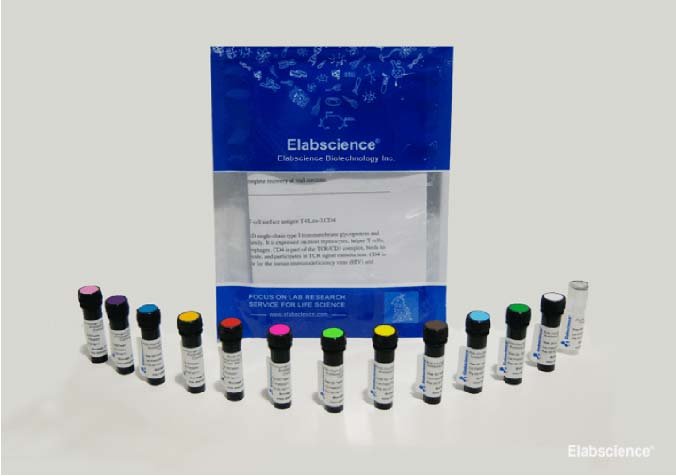
Manufacturer: Elabscience
This product is a FCM antibody cocktail made up of FITC Anti-Human CD3 Antibody [Clone: OKT-3] (Mouse IgG2a, κ), PE Anti-Human CD16 Antibody [Clone: 3G8] (Mouse IgG1, κ) and PE Anti-Human CD56 Antibody [Clone: 5.1H11] (Mouse IgG1, κ).; CD3 is a heterotetrameric protein consisting of a CD3γ, a CDδ and 2 CD3ε. It forms complex with TCR. OKT-3 recognize human CD3ε. Human CD3 is expressed on the surface of T cells and NKT cells.; CD16 is a low affinity receptor for the Fc of IgG. Human CD16 has two isoforms, CD16a and CD16b. CD16a is expressed on NK cells, activated monocytes and macrophages. CD16b is expressed on neutrophils. NK cells exert the function of ADCC by binding Fc of IgG through CD16.; CD56 is also call neural cell adhesion molecule (NCAM), expressed on neurons, glia and skeletal muscle cells. In hematopoietic cells, CD56 is also expressed on NK cells and NKT cells. CD56 can be used to detect NK cells, γ/δ T cells and activated CD8+ cells.;
![APC Mouse IgG1, κ Isotype Control[MOPC-21] (E-AB-F09792E)](https://www.unibiotech.in/upload/product/b9ebp0.IYAPE6.jpg)
Manufacturer: Elabscience
The APC Mouse IgG1, κ Isotype Control [MOPC-21] (Catalog No. E-AB-F09792E) from Elabscience is a monoclonal antibody conjugated with Allophycocyanin (APC), designed for use as an isotype control in flow cytometry applications. Isotype controls are essential for distinguishing non-specific binding from specific antibody interactions, ensuring accurate interpretation of flow cytometric data.
![FITC Anti-Human CD86 Antibody[BU63] (E-AB-F1012C)](https://www.unibiotech.in/upload/product/uxpmlg.KqfcB2.jpg)
Manufacturer: Elabscience
CD86 is an 80 kD immunoglobulin superfamily member also known as B7-2, B70, and Ly-58. CD86 is expressed on activated B and T cells, monocytes/macrophages, dendritic cells, and astrocytes. CD86, along with CD80, is the ligand of CD28 and CD152 (CTLA-4). CD86 is expressed earlier in the immune response than CD80. CD86 has also been shown to be involved in immunoglobulin class-switching and triggering of NK cell-mediated cytotoxicity. CD86 binds to CD28 to transduce costimulatory signals for T cell activation, proliferation, and cytokine production. CD86 can bind to CD152 as well, also known as CTLA-4, to deliver an inhibitory signal to T cells.
![PE Anti-Human CD5 Antibody[UCHT2] (E-AB-F1041D)](https://www.unibiotech.in/upload/product/xho0ud.MaatQj.jpg)
Manufacturer: Elabscience
CD5 is a 67 kD single chain type I glycoprotein also known as Leu-1, Ly-1 and T1. It is a member of the scavenger receptor superfamily found on T cells, thymocytes, B cell subsets, chronic B lymphocytic leukemia (B-Cells), and peripheral blood dendritic cells. CD5 modulates T and B cell receptor signaling, thymocyte maturation, and T-B cell interactions upon binding to ligands such as CD72.
![PE Anti-Human/Mouse CD44 Antibody[IM7] (E-AB-F1100D)](https://www.unibiotech.in/upload/product/jte9m5.hhsdVJ.jpg)
Manufacturer: Elabscience
CD44 is a 80-95 kD glycoprotein also known as Hermes, Pgp1, H-CAM, or HUTCH. It is expressed on all leukocytes, endothelial cells, hepatocytes, and mesenchymal cells. As B and T cells become activated or progress to the memory stage, CD44 expression increases from low or mid levels to high levels. Thus, CD44 has been reported to be a valuable marker for memory cell subsets. High CD44 expression on Treg cells has been associated with potent suppressive function via high production of IL-10. CD44 is an adhesion molecule involved in leukocyte attachment to and rolling on endothelial cells, homing to peripheral lymphoid organs and to the sites of inflammation, and leukocyte aggregation.