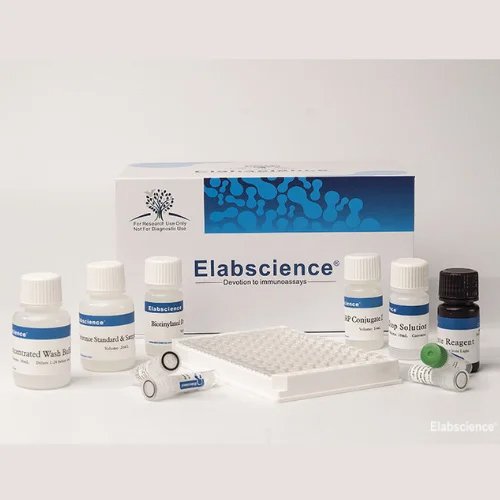
Manufacturer: Elabscience
TNFα is a homotrimer with a subunit molecular mass of 17 kD cytokine that binds to TNFRSF1A/TNFR1 and TNFRSF1B/TNFBR. It is mainly secreted by macrophages and can induce cell death of certain tumor cell lines. It plays a major role in growth regulation; differentiation; inflammation; viral replication; tumorigenesis; autoimmune diseases and in viral; bacterial; fungal; and parasitic infections. Besides inducing hemorrhagic necrosis of tumors; TNF was found to be involved in tumorigenesis; tumor metastasis; viral replication; septic shock; fever; inflammation; and autoimmune diseases including Crohn’s disease; and rheumatoid arthritis as well as graft-versus-host disease.
Manufacturer: Elabscience
Human Vitronectin/VTN is a cell adhesion and spreading factor. It can be found in the blood and the extracellular matrix (ECM). Vitronectin interacts with glycosaminoglycans and proteoglycans. The multimeric Vitronectin can efficiently bind to and incorporate into the ECM; Vitronectin can support cell adhesion through binding to various integrins and other proteoglycans. Vitronectin can be recognized by certain members of the integrin family and serves as a cell-to-substrate adhesion molecular. It can as a inhibitor of the membrane-damaging effect of the terminal cytolytic complement pathway. Vitronectin contains an endogenous cleavage site; plus cleavage sites for elastase; thrombin; and plasmin.
Manufacturer: Elabscience
Serotransferrin belongs to transferrin family, and contains 2 transferrin-like domains. The protein is a secreted protein, and expressed by the liver and secreted in plasma. Transferrins are iron binding transport proteins which can bind two Fe3+ ions in association with the binding of an anion. It is responsible for the transport of iron from sites of absorption and heme degradation to those of storage and utilization. Serum transferrin may also have a further role in stimulating cell proliferation.
Manufacturer: Elabscience
Human β-Nerve Growth Factor (β-NGF) was initially isolated in the mouse submandibular gland. It is composed of three non-covalently linked subunits α; β; and γ; it exhibits all the biological activities ascribed to NGF. It is structurally related to BDNF; NT-3 and NT-4 and belongs to the cysteine-knot family of growth factors that assume stable dimeric structures. Β-NGF is a neurotrophic factor that signals through its receptor β-NGF; and plays a crucial role in the development and preservation of the sensory and sympathetic nervous systems. Β-NGF also acts as a growth and differentiation factor for B lymphocytes and enhances B-cell survival. These results suggest that β-NGF is a pleiotropic cytokine; which in addition to its neurotropic activities may have an important role in the regulation of the immune system. Human β-NGF shares 90% sequence similarity with mouse protein and shows cross-species reactivity.
Manufacturer: Elabscience
Transforming growth factor beta 1 (TGFβ1) is the prototype of a growing superfamily of peptide growth factors and plays a prominent role in a variety of cellular processes, including cell-cycle progression, cell differentiation, reproductive function, development, motility, adhesion, neuronal growth, bone morphogenesis, wound healing, and immune surveillance. TGF-β1, TGF-β2 and TGF-β3 signal via the same heteromeric receptor complex, consisting of a ligand binding TGF-β receptor type II (TβR-II), and a TGF-β receptor type I (TβR-I). Signal transduction from the receptor to the nucleus is mediated via SMADs. TGF-β expression is found in cartilage, bone, teeth, muscle, heart, blood vessels, haematopoitic cells, lung, kidney, gut, liver, eye, ear, skin, and the nervous system.
Manufacturer: Elabscience
Weakly binds calcium but binds zinc very tightly-distinct binding sites with different affinities exist for both ions on each monomer. Physiological concentrations of potassium ion antagonize the binding of both divalent cations, especially affecting high-affinity calcium-binding sites. Binds to and initiates the activation of STK38 by releasing autoinhibitory intramolecular interactions within the kinase. Interaction with AGER after myocardial infarction may play a role in myocyte apoptosis by activating ERK1/2 and p53/TP53 signaling. Could assist ATAD3A cytoplasmic processing, preventing aggregation and favoring mitochondrial localization. May mediate calcium-dependent regulation on many physiological processes by interacting with other proteins, such as TPR-containing proteins, and modulating their activity.
Manufacturer: Abbkine Scientific
EGF is the founding member of the EGF-family of proteins. Members of this protein family have highly similar structural and functional characteristics. EGF contains 9 EGF-like domains and 9 LDL-receptor class B repeats. Human EGF is a 6045-Da protein with 53 amino acid residues and three intramolecular disulfide bonds. As a low-molecular-weight polypeptide, EGF was first purified from the mouse submandibular gland, but since then it was found in many human tissues including submandibular gland, parotid gland. It can also be found in human platelets, macrophages, urine, saliva, milk, and plasma. EGF is a growth factor that stimulates the growth of various epidermal and epithelial tissues in vivo and in vitro and of some fibroblasts in cell culture. It results in cellular proliferation, differentiation, and survival. Salivary EGF, which seems also regulated by dietary inorganic iodine, also plays an important physiological role in the maintenance of oro-esophageal and gastric tissue integrity. EGF acts by binding with high affinity to epidermal growth factor receptor on the cell surface and stimulating the intrinsic protein-tyrosine kinase activity of the receptor. The tyrosine kinase activity, in turn, initiates a signal transduction cascade that results in a variety of biochemical changes within the cell - a rise in intracellular calcium levels, increased glycolysis and protein synthesis, and increases in the expression of certain genes including the gene for EGFR - that ultimately lead to DNA synthesis and cell proliferation.
Manufacturer: Prospec Bio
Il-6 is a cytokine with a wide variety of biological functions: it plays an essential role in the final differentiation of b-cells into ig-secreting cells, it induces myeloma and plasmacytoma growth, it induces nerve cells differentiation, in hepatocytes it induces acute phase reactants.
Manufacturer: Prospec Bio
IL 1 alpha Rat Recombinant produced in E.Coli is a single, non-glycosylated polypeptide chain containing 179 amino acids (115-270 a.a) and having a molecular mass of 20.2kDa. IL 1 alpha is fused to a 23 amino acid His-tag at N-terminus & purified by proprietary chromatographic techniques.