
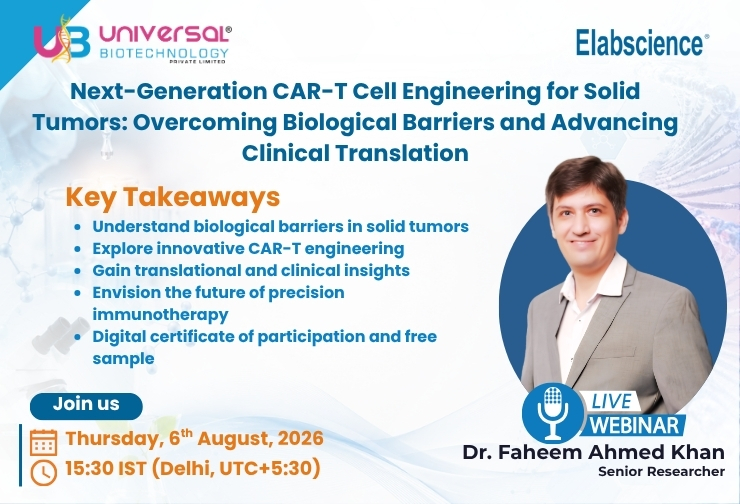
Elabscience® recently hosted an insightful scientific webinar titled “Next-Generation CAR-T Cell Engineering for Solid Tumors: Overcoming Biological Barriers and Advancing Clinical Translation.” The webinar explored the rapidly evolving field of CAR-T cell therapy and the engineering strategies being developed to address some of the major challenges associated with treating solid tumors.
While CAR-T cell therapy has transformed the treatment landscape for several hematological malignancies, its application to solid tumors remains challenging. Factors such as tumor heterogeneity, an immunosuppressive tumor microenvironment, limited T-cell persistence, and difficulties in achieving effective tumor infiltration and recognition can restrict therapeutic efficacy.
The webinar brought together perspectives from cellular therapy, cancer immunology, and translational research to highlight how next-generation CAR-T engineering could help overcome these biological barriers and expand the potential of precision immunotherapy.
Webinar Overview
The session focused on emerging approaches for improving CAR-T cell performance against solid tumors, with particular emphasis on the interaction between engineered immune cells and the complex tumor microenvironment.
Key areas discussed included:
Tumor Microenvironment Challenges: Understanding how immune suppression, tumor heterogeneity, and other biological barriers can limit CAR-T cell activity within solid tumors.
Next-Generation CAR-T Engineering: Exploring innovative strategies for optimizing CAR-T cell design and improving their functional capabilities.
Immune Recognition and Persistence: Examining approaches aimed at enhancing tumor recognition, CAR-T cell activity, and persistence within challenging tumor environments.
Translational and Clinical Perspectives: Understanding how advances in CAR-T engineering and tumor microenvironment modulation may contribute to the development of more effective cellular immunotherapies.
Overcoming the Challenges of Solid Tumors
Unlike many blood cancers, solid tumors present a highly complex physical and biological environment. CAR-T cells must successfully reach the tumor, recognize the appropriate target, remain functional in an immunosuppressive environment, and maintain sufficient activity to produce a meaningful therapeutic response.
Next-generation CAR-T research is therefore moving beyond conventional receptor engineering. Researchers are investigating strategies that combine advanced receptor design, cellular engineering, immune modulation, and tumor microenvironment remodeling to improve the overall performance of CAR-T cells.
These developments could help address limitations in tumor targeting, immune recognition, T-cell persistence, and functional activity - key factors in advancing CAR-T therapy for solid malignancies.
Key Takeaways for Researchers
The webinar provided valuable insights into several important areas of contemporary CAR-T research:
* A better understanding of the biological barriers limiting CAR-T therapy in solid tumors
* Emerging approaches for optimizing CAR-T cell engineering and functionality
* Strategies to improve immune recognition and CAR-T cell persistence
* The importance of tumor microenvironment modulation in cellular therapy
* Translational perspectives on advancing next-generation CAR-T approaches toward clinical applications
Together, these developments highlight the importance of integrating cell engineering, molecular biology, cancer immunology, and translational research to develop more effective cellular therapies.
Speaker:
Dr. Faheem Ahmed Khan
Senior Researcher, Stem Cell & Cancer Research (SCCR), Indonesia
Dr. Faheem Ahmed Khan specializes in stem cell biology, molecular immunology, and cancer immunotherapy. His research focuses on CRISPR/Cas9 genome engineering and tumor microenvironment modulation to develop next-generation CAR-T cell therapies for solid tumors.
Researchers, scientists, and professionals working in cancer research, immunology, cell biology, stem cell research, and translational medicine can access the webinar to learn more about emerging CAR-T engineering strategies and their potential applications in solid tumor research.
Watch now for more info: